Repairing the "I'm Bad at Math" Attitude


After teaching middle school math for almost five years, I have found that one of the biggest hurdles and misconceptions for students is their attitude and confidence in their own math abilities. As a math teacher, one huge challenge is changing the "I'm bad at math" attitude that some students enter the year with. Of course, not all students carry this attitude with them. Many students are confident in their math skills. However, I think that making a dent in the attitude of students who lack that confidence might be the most important, and challenging, part of teaching math. Here are a few classroom routines and ideas that I have found to help repair and change the "I'm bad at math" mindset.


(1) Make Math Fun
After reflecting on my first year of teaching 6th grade math, I found out very quickly that I needed to make math fun and engaging. I think the first step in changing the attitude of students who have struggled in math is making math class a place they enjoy coming to. One of the classroom routines I started is the Math Joke of the Week. It takes about 10 minutes per week to look up a fun (or corny) math joke and get it up on the board. Students love it when the joke is something they can try to guess, and I always hear about it quickly when I forget to get a new joke up.


Incorporating some random fun routines and things around the classroom can also start to get these students to enjoy coming into math class. Last year, I blogged about some of the fun things around my classroom. Although a lot of these aren't math related, I think they can help the general attitude of the students who come into the class!

https://www.teacherspayteachers.com/Product/Connect-Four-Multiplying-Decimals-1943728I also have tried to make the learning process more fun for my students. In 6th grade math, we play a lot of math games that reinforce the concepts we are learning about. I've created many of these, but have also found a ton of awesome ideas floating around as well. My students love playing this Kaboom (also called Zap) game, which I adapted to practice solving equations. One of the other favorites are the Connect Four games that I created for various topics. My Connect Four: Multiplying Decimals is a freebie in my TpT store! As much as possible, I have tried to make learning and practicing our math concepts into some sort of game or engaging activity.


(2) Get Kids Moving
Many of my lessons during my first year of teaching involved me at the overhead projector (yes, I was still using an old-school overhead projector) and students at their seats watching me do examples. Reflecting on that first year, I discovered a few things. Number one, I probably damaged my eyesight by looking into that dang projector all day. Two, I was doing most of the work while students sat and watched. And three, a lot of the time students weren't sitting and watching... they were doing something they weren't supposed to be doing, not paying attention, or just flat out bored (and looking back I don't blame them). This structure made it difficult for me to reach the students who felt they were bad at math. I switched to a math workshop structure, where students rotate around the room to different stations each class period. This structure allows me to meet in a small group with all students, which helps me reach the students that normally struggle. Whether it's math workshop, or some other structure, I feel like it is important to get students out of their seats. Of course that's not to say we never have stretches where we are taking notes, watching me do problems, etc., but I have tried to limit the length and amount of these. More details about how I run the math workshop are at the tab at the top of my blog!


(3) Challenge Students
https://www.teacherspayteachers.com/Product/Challenge-of-the-Week-6th-Grade-Math-1904489All students enjoy a challenge and some competition... at least if there is a prize involved! Although my Challenge of the Week problems are often completed by my students who are very confident and strong in math, I was pleasantly surprised by the number of students who try these problems. There is nothing more rewarding than when a student who usually finds math difficult, gets the challenge problem. I put up a new problem every Monday. Students have until Thursday to enter (it's optional). On Friday, we go over and discuss the answer as a class - any correct answers get a mint! This is another routine that is pretty easy to set up, takes minimal time each week, and is a great way to stretch students thinking! If you are looking for some 5th/6th grade level problems, a full-year set is free in my store. The optional, low-risk, nature of the Challenge of the Week really encourages everybody to try it since there isn't any penalty for getting it wrong.

Area Review (Parallelograms, Triangles, Trapezoids, and more!)

It has been all about finding areas recently in sixth grade math! The last week or two, we have been finding the area of parallelograms, triangles, trapezoids, and circles (with some perimeter and circumference thrown in there too!). For a while now, I have been trying to find a good way to review these concepts. This last week, I thought I would try an activity that worked pretty well last year with my sixth graders during our volume unit. This activity gets students up out of their seats, moving around the room, talking about math, and analyzing each others work!

I began by creating six different posters that each focused on a specific concept. I started pretty basic, with the area of a parallelogram. The other five focused on the area of a triangle, area of a trapezoid, area of a circle, circumference, and one challenge problem! Each student started by getting 6 different colored Post-it notes. On each of the posters, I put one of these different colored Post-its in the corner, so students knew which color to do their work on for that problem. After assigning them a  poster to start at (3-5 students per poster), they went around the room solving each problem on their Post-it notes. Here are a few shots of them in action!


Once students got to their starting point, I gave about two or three minutes for them to solve that problem on their Post-it note. After the time was up, I had them rotate to their next poster. I debated having them just go around at their own pace, but this system of sticking together with their group seemed to work out pretty well! I was impressed with the great math conversations going on as they worked! There was a lot of "but don't we need to double the radius" and "it's a triangle, so we have to divide by two!" Once they had all gotten to each station, I gave them a minute or two to go back to any problems that they had not had time to finish. Then, once we were all ready, the students went around an placed their work (which was on each Post-it note) on to the correct poster. Each poster looked something like this...


Then, here was my favorite part. I gave the students three minutes to walk around and look at the work of their classmates. To give them something specific to look for, I had them try to find at least one thing we did well as a class and at least one mistake they found. The students really enjoyed walking around and looking at their work and it was a great way to spark a discussion about the different area problems we had been learning about. Here are a few pictures of students as they were analyzing each others work!


I really enjoyed using this one as a review and I love how it could really be used with any concept! I'd love to hear any questions or similar activities that you have tried in your classrooms!

Looking for more ideas to help review area concepts? Check out a few of these interactive activities from my TpT store!


https://www.teacherspayteachers.com/Product/Area-and-Perimeter-Sort-2079482


https://www.teacherspayteachers.com/Product/Area-Invasion-A-Math-Board-Game-3558362
 

Angles, Triangles, and the Start of Geometry in 6th Grade Math!

With the beginning of our geometry units in 6th grade math, it has been all about angles and triangles this past week! Thanks to some creative (and cheap!) angle ideas I found on social media, I was able to incorporate some new things in my classroom this year as we start geometry! First off, this fun idea to reinforce a basic understanding of angles! With some leftover fun tape from Office Depot, a little card stock to write the angles, and about ten minutes, I made this fun entryway into the classroom. I can't take credit for the idea, but am happy to share it! It definitely caught the students attention and had them thinking about different angles!

The second fun idea I found (again... can't take credit for this one) I was able to use with my math intervention groups this week. After we had learned about different angle relationships (vertical angles, supplementary angles, and complementary angles), I covered our front dry-erase table with table at various angles. I then went through and measure the minimum number of angles they would need to be able to find all of the missing angles without a protractor. This turned out to be a great problem solving challenge and really promoted teamwork and working together. I could also see this working out great as a math center during math workshop.

UPDATE: I recently added a full set of Angle Relationships Task Cards to my TpT store! It currently includes over 70 challenging angle problems and 4 different levels of difficulty!


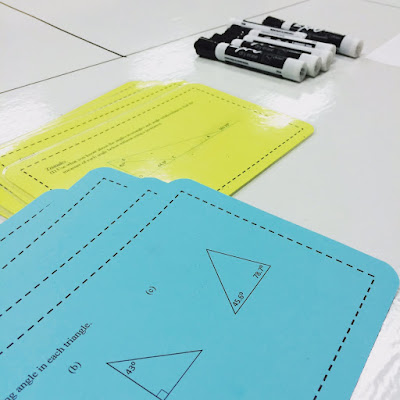
With the start of geometry, I was also able to try out one of my newest units of Math Task Cards: Triangles, Quadrilaterals, and Transformations. I now have two sets of task cards up in my store. A set of Math Task Cards, which are a little more basic problems. Then, for students that finish these quickly, I have them try the Math Enrichment Task Cards. Having these more challenging task cards makes it easy to push my higher students and keep them challenged! Here are a couple shots of the prep and final product of some of these task cards. I always print out six cards for each topic, which is what I need for my math workshop front table group. If I have time I corner round the corners and laminate to help them last!

https://www.teacherspayteachers.com/Product/Math-Task-Cards-Full-Year-Bundle-6th-Grade-Math-2273242

https://www.teacherspayteachers.com/Product/Math-Enrichment-Full-Year-Bundle-6th-Grade-Math-Task-Cards-1544508

Geometry has also allowed me to finally get to what is probably my favorite Challenge of the Week problem! I recently updated this freebie with five more questions that could be used, so be sure to re-download it if you have already grabbed this one from my store in the past!

https://www.teacherspayteachers.com/Product/Challenge-of-the-Week-6th-Grade-Math-1904489

So that's what we have been up to in 6th grade math recently. I'd love to hear what you have all been working on in your classrooms! And how about some humor to get everyone on their way? Who knew that One Direction is now a swear word?


Free Pi Day Challenge and a Freebie Bundle!


It has been a busy end to the quarter in 6th grade math. We are close to wrapping up our three units focused on algebra, we STAR tested this week, and had our annual end of semester middle school field trip to reward students for all of their hard work! It seemed like a good morning to get out this awesome new coffee mug I got for Christmas and get back to the blog!

I recently put together a new Free Pi Day Challenge activity and a Freebie Bundle in my TpT store, which will be the focus here today! The Pi Day Challenge is brand new to my store (although I have done it for a few years now in my classroom) and the Freebie Bundle is just a combination of all of the free products in my store. I hope you can find a use for some of them with your students!

With Pi Day right around the corner, I thought it would be a good time to share this fun challenge! It's pretty basic, but there is a ton of math involved and it has proven to be really engaging for students. I usually start Pi Day by reading the book Sir Cumference and the Dragon of Pi, written by Cindy Neuschwander. It really is a great book that shows how pi is found - which is by dividing the circumference of a circle by its diameter!

In this challenge, students do exactly that! The activity includes four circles of difference sizes. I make a bunch of copies of each of the sizes. Students, in partners or individually, must pick a circle to use for the challenge. Once a circle is picked, they grab some yarn and a ruler. The challenge is to measure the circumference of the circle (using the yarn as picture below), measure the diameter using their ruler, divide, and see which group can get the closest to 3.141592...! After doing this for a few years now, here are a few tips. First, depending on your class, you may want to review measurements and the fractional parts in between each inch or centimeter. They will want to be as exact as possible and don't want to become frustrated if they don't understand how to measure their dimensions accurately! Second, when measuring the circumference, you don't want to pull the string too tight when straightening it out. You want to straighten it out (so you can measure it), without pulling it too tight and adding extra length that isn't actually a part of the circumference!

https://www.teacherspayteachers.com/Product/Pi-Day-Challenge-Math-in-the-Upper-Grades-2295128

https://www.teacherspayteachers.com/Product/Pi-Day-Challenge-Math-in-the-Upper-Grades-2295128

After creating this free challenge, I thought it would be convenient to throw all of my free products into one Ultimate Freebie Bundle! Most of these have been available for some time now, but now they are all in one place. This bundle will also be updated every time I add a new free product to my store. Here is a quick snapshot of everything that is included!

1. Math Task Cards (Decimals and Exponents)
This is one of my more recent freebies! These task cards are a simple version of my Math Enrichment task cards. This is the first unit, which is up for free in my store. A full-year bundle is also available, which includes all 12 units!

https://www.teacherspayteachers.com/Product/Math-Task-Cards-Decimals-and-Exponents-6th-Grade-Math-2190163

2. Math Enrichment Task Cards (Decimals and Exponents)
These are the task cards I mentioned above! These are great for students who are catching on to a concept quickly and need a challenge! This unit, focused on decimals and exponents, is free. Again, a full-year bundle is also available!

https://www.teacherspayteachers.com/Product/Math-Enrichment-Problems-Decimals-and-Exponents-6th-Grade-1360872

3. Challenge of the Week Problems
Here is the full-year set of my Challenge of the Week problems for 6th grade math! If you follow me on Instagram, you have probably seen some of these (@middleschoolmathman)! These are optional for students to try each week and I give a small prize to any correct answers.

https://www.teacherspayteachers.com/Product/Challenge-of-the-Week-6th-Grade-Math-1904489

4. Connect Four: Multiplying Decimals
This Connect Four game is the first of fourteen Connect Four games in my store. These have been extremely useful this year, especially during my math intervention time to use as a review. They also work great as math centers! If you are interested in the full set of Connect Four games you can find them here!

https://www.teacherspayteachers.com/Product/Connect-Four-Multiplying-Decimals-1943728

5. Equation Memory: Addition Equations
This Equation Memory game helps students practice solving addition equations. On their turn, students flip over two cards and are trying to match the equation to its solution. Another fun one for review or as a math center! An Equation Memory Bundle is also available in my store, which also includes subtraction equations, multiplication equations, division equations, two-step equations, and inequalities!

https://www.teacherspayteachers.com/Product/Equation-Memory-Addition-Equations-1680829

6. Math Curse Challenge
Fun and easy to prep challenge if you have a copy of the book Math Curse. Students must try to answer some of the crazy and wacky math problems from the book!

https://www.teacherspayteachers.com/Product/Math-Curse-Challenge-Questions-1519455

7. Scavenger Hunt (Number System)
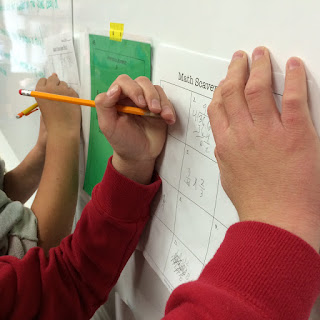
I started using scavenger hunts as a way to review towards the end of last year and am mad at myself for not doing them sooner! This one focuses on the number system (including multiplying/dividing decimals and fractions, exponents, and more). I also have several more scavenger hunts available for purchase as a part of my Scavenger Hunt Bundle!

https://www.teacherspayteachers.com/Product/Math-Scavenger-Hunt-Number-System-1901461

8. Blueprint Project
Lesson plans for this architectural blueprint project I do each year with my students! They must design a dream house or building on grid paper and then enlarge it (to scale) onto the poster board. They always have a lot of fun with this one!

https://www.teacherspayteachers.com/Product/Blueprint-Project-Geometry-Math-Project-for-Upper-Grades-1717785

https://www.teacherspayteachers.com/Product/Blueprint-Project-Geometry-Math-Project-for-Upper-Grades-1717785

9. Percent Scramble
Percent Scramble is a fun and easy to prep math game that helps students practice finding the percent of a number... with some friendly competition of course! They must flip over a percent card and a whole number card. Once they find that percent of their number, they record their score for the round!

https://www.teacherspayteachers.com/Product/Percent-Scramble-Finding-the-Percent-of-a-Number-1563526

10. Pi Day Challenge
Check out the start of this post! :)

I hope you can all find a use for some of these activities in your classroom! I intend to update the Freebie Bundle every time I get a new free product up in my store, so make sure you stay tuned! Enjoy the weekend everybody!
 

Math Task Cards and the Teacher Center

Well, it took a little bit longer than I expected, but my new Math Task Cards are finally all finished and ready to go! Last year, I created a full-year set of Enrichment Task Cards, pictured below, to use at my Teacher Center during my 6th grade math workshop. I found these enrichment problems extremely useful and engaging for any of my students who grasped the basic concept quickly and needed a challenge.

https://www.teacherspayteachers.com/Product/Math-Enrichment-Full-Year-Bundle-6th-Grade-Math-Task-Cards-1544508

What I didn't have, was a good method to display/give the more basic problems to these students - the problems that I use to determine if each students understands the basic concept. I had tried writing them on the board behind me and writing them on a mini-white board and holding it... both of which were annoying and sucked a lot of prep time out of my day (having to think of and write these problems every day!). That's when I decided to start making a set of more basic task cards (as opposed to my Enrichment Task Cards) for my students to use. That way I could give them the basic task card to work on first and if they finished that one easily, I could hand them the enrichment task card. Just recently, I finished up all twelve sixth grade math units and included them all in my Math Task Cards Full-Year Bundle. So far, it has worked out great! Here is a shot of the cards set out and ready for my students!

https://www.teacherspayteachers.com/Product/Math-Task-Cards-Full-Year-Bundle-6th-Grade-Math-2273242

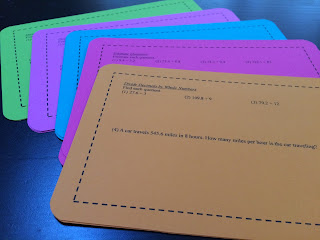
I love how convenient and easy to distribute these cards are. Although it takes a little extra time, I usually try to cut, round the corners (with a corner rounder from Target), and laminate my copies. Since I use them within the math workshop structure, I only need six copies of each - since my largest group has six students. I have found the extra step of laminating, as you teachers all know well, saves a lot of time in the long run! By the way, if you are curious about the dry-erase table... be sure to check out my post about how I turned my front table into this fun classroom work space!

Here is another shot of these task cards up close. The topics span a whole range of math concepts... multiplying/dividing decimals and fractions, ratios, percents, algebraic expressions, equations, geometry, probability, and more! I use these with my 6th graders, but they could also be used in 5th or 7th grade for different students. If you are curious about the level of the cards, I would recommend checking out my first unit for free, which focuses on decimals and exponents!

https://www.teacherspayteachers.com/Product/Math-Task-Cards-Full-Year-Bundle-6th-Grade-Math-2273242

*Update: With my transition to teaching 8th grade math, in addition to 6th grade, I created task cards for 8th grade math as well! You can check out the two full-year sets at the following links!


I hope you all have a great second half of the year!

Dry Erase Table Update...3 months later

I thought it is about time I give some updates on the biggest change to my classroom this year...our new dry erase table! Earlier this school year, I wrote about the process of turning my front table into a giant dry erase board for students to use during our 6th grade math workshop. Click HERE for that linnk. A can of primer and dry erase paint later, here is what the initial result was... a brand new (and shiny!) table.


The students have absolutely loved using the table. We used it almost every single day during our math workshop at the "Teacher Center." At this center, I give students 3-4 problems to try and I can help as needed. I recently began creating task cards of these problems (I was tired of holding up the problems on a white board!). Click HERE for a free copy of the decimal and exponent problems (and check out my store for other units - more are still in the works!). If students fly through these initial problems, then I give them an enrichment task card that is focused on whatever math concept we are learning. A full set of these enrichment task cards has been available in my TpT store for a while - if you are interested in a copy click this link: Math Enrichment Task Cards. The dry erase table has been perfect for students to use as we complete these problems. I can easily check to see if they are on the right track as they work!

My biggest concern with the table going in was how it would hold up. I bought the cheapest dry erase paint from Home Depot... I think it was about $20 if I remember correctly. I'd say on a scale of 1-10, I would give it about a 7.5 as far as its condition after three months. This is after pretty heavy use I might add. Each spot on the table gets used by 12 groups a day, which means 12 students per spot. Each of those students is doing approximately 5 problems each day at that spot. That adds up to each spot being used and erased about 60 times per day! Here is what the table currently looks like.


It's a little tough to see with the glare, but the heavily used spots are definitely not perfectly white anymore... but honestly, this doesn't really bother me. For how much students enjoy using it and how convenient it is to use during math workshop, it is definitely worth it. Other than it not being perfectly shiny, the only other minor issue has been a few small chips or cracks in the paint. I am considering putting on a fresh coat of the dry erase paint over winter break, although it wouldn't be necessary. So what's my opinion on how the table is working? Even though it isn't a perfect white (I was never expecting it to stay that way!) and there are a few small cracks in the paint, I am happy with how it has worked in my classroom and would 100% do it again.

Here are a few more shots of the table in action! If you have questions about the table, let me know in the comments!