Volume Review Activity for 6th Grade Math

A rainy Friday night has given me a chance to get back in the blogging world (I coach baseball, so the the free nights these days are few and far between!). In 6th grade math, we just finished up our unit on volume. During my first few years of teaching, I found that this is an area that 6th graders often struggle to grasp right away. I decided to spend an extra couple of days reviewing and practicing how to find the volume of rectangular prisms, triangular prisms, pyramids, cylinders, and cones! The question was...what should we do to help review?

It's amazing how sometimes the last minute teaching ideas often turn out the best! This was one of those "night before" ideas that I thought I'd give a try. To start, I spent about 15 minutes creating these volume posters on five pieces of poster board.


After taping the five posters up around the room, I gave each student five post-it notes. I had them label their post-it notes with the five different figures. Then, I divided the class into five groups...each group starting at a different poster. I gave each group 3-4 minutes to find the volume of their shape. Each student was required to show their work on their own post-it, but I encouraged them to work with their group members if they got stuck. I made sure to emphasize that if they got done early they should help out their group members who were still working! Here are some pictures of my students hard at work!


After having all five groups rotate to each station, I had students place their five post-it notes on the matching poster. I had them wait to do this step at the end (rather then as they did each problem) so that other groups wouldn't see the work that they had done. Here are the five posters with their post-it notes attached!


After placing their post-it notes on the posters, I brought the class back together. Giving them three minutes to walk around the room, I had them look for two specific things. Number one...things that we did well as a class. Number two...any mistakes they saw and how to correct them. This final step of the activity was very insightful. Before having them walk around, I made sure to stress the idea that if they could find another student's mistake and explain how to fix it, that it showed that they really understood the concept. I was impressed by how many students could do this!

This was such an easy and effective review activity that I had to share! I also love how it could be applied to almost any concept. I plan on using this structure for a review activity at the end of each of my units!

Blueprint Project for Upper Elementary Math

Every year I look forward to our geometry units for several reasons. Not only is it one of my favorite subjects to teach, I also get to introduce our Blueprint Project to the sixth graders! After seeing (and somehow remembering!) the previous year's blueprints out in the hallway, the current sixth graders have been asking throughout the year, "When are we going to do those blueprint projects?" Now that we have wrapped up the entire project, I wanted to take some time to write about the projects from start to finish! The link below is a free copy of the packet I give to students at the beginning of the project. Although this is free, you will also need some additional materials for each student (poster board, graph paper, colored pencils, Sharpies, etc.).

Blueprint Project

The first step of the Blueprint Project is for students to create a building of their choice on a piece of graphs paper. Often times, this is their favorite part! They love the open-ended nature of being able to design any type of building, with anything in it. Lots of students design dream houses, but I always look forward to seeing the creativity of the students when picking the type of building. I have seen everything from animal rescue centers to aquariums! On their graph paper blueprints, they must have all angles/wall lengths measured and labeled. In addition, I require the students to double each of their lengths and write this in parenthesis. This is very helpful later on when they are enlarging their blueprints! Here is a picture of one of my students designing their blueprint.


Once their graph paper blueprint is drawn and labeled, each student gets a large piece of poster board. On the poster board, they must enlarge their original blueprint to twice the size. I have used other scale factors before but have found that having everyone multiply by two ensures that it will fit on the poster board! It is extremely important to stress accuracy when measuring and drawing the angles and lengths. If the students aren't accurate, then they will have wall lengths or angles that don't line up on their final blueprint! Here are a few pictures of my students working on their final blueprints. I am always amazed at the detail some of my students include on their projects!


Finally, the last stage of the blueprints...adding colors and detail! Once all of their walls are drawn in pencil, the students can begin to add details, outline their walls with Sharpies, and use colored pencil to add some color. All of the details do not need to be measured (couches, tables, chairs, etc.). Here are some of the creative designs my students came up with this year! Some of my students really spent a lot of time outside of class making their projects look great!


As always, I'd love to hear any questions you might have about the projects! If you are thinking of trying out the project with your students, let me know and I'd be happy to provide some useful tips when introducing the Blueprint Project for the first time. Have a great week everyone!

Pi Day Challenge (that doesn't involve memorizing numbers!)

Every year it seems like I've added one new thing to our Pi Day festivities in sixth grade math! This time, it was a result of Pi Day falling on a Saturday (and the ultimate Pi Day at that...3.1415 = 3/14 in the year 15). On Saturday, 3/14, I am challenging my students to send me an email at exactly 9:26am with 53 seconds with the subject 3.141592653...

3.141592653...= 3/14/15 at 9:26:53

And the best part? The winner is going to get 3.14 packs of gum! Needless to say, this was quite the motivation for the sixth graders! Stay tuned for more Pi Day festivities (pictures included) as well as a post about our Blueprint Projects we are just finishing up! Happy Pi Day everyone!

Coordinate Cities


We have been working hard in 6th grade recently, having just finished up our three units that focus on algebra. It has been great to see the transformation of the sixth graders! Most come in to these units barely having an idea of what algebra is and they come out writing and solving two step equations and inequalities! The last couple of years I have introduced a Coordinate City Project at the end of these units. Since the last couple of lessons focus on graphing, this one is a nice review of ordered pairs and the coordinate plane! In the project, students get to design a themed city on the coordinate plane. Once their city is complete, they must ask at least three questions that require ordered pairs to answer. The picture here is my example that I use to show the class!

The students always really get into this one! I think it is a combination of being able to pick a fun theme along with the open ended idea of being able to design a city! It is always fun to see some of the the funny and creative themes that they choose. I think the one that made me laugh the most this year was this Miley Cyrus themed city - including the Mall of Miley, Wrecking Ball Ave, and Sticking Tongue Out Street!


One part of the Coordinate Cities that I really enjoy is the creativity it allows for students. After all of the hard work and practice that we do during our algebra units, this project is a nice change of pace for the 6th graders. For my students who finish early, I give them the option of creating a business card to go along with their cities. As you can see, some of the business cards get pretty creative and funny! I couldn't help but laugh at this 6th graders sense of humor!


Can't believe the year is flying by so fast, but we are already set to get going with geometry! More geometry related posts to come soon!

The Math Curse!

This book and activity are just too great not to share! I actually did this with my sixth graders a while back (right before Thanksgiving!) but am just getting around to writing about it. Many of you have probably already read or heard about the hilarious book, The Math Curse, by Jon Scieszka and Lane Smith. These are the same authors as The True Story of the Three Little Pigs. If you haven't read Math Curse, it is definitely worth finding a copy and reading with your students. It will get them thinking, laughing, and learning about some fun math concepts!

In addition to reading the book, the last few years I have made it into a challenge for my middle schoolers. For those of you who have not had the pleasure of reading it yet, the main character falls victim to a math curse, resulting in everything turning into a math problem! The questions are engaging, wacky, and math related (well...some of them). I decided to put together a worksheet with many of the questions from the book. After reading the book with my students, I let them work individually or with a partner to answer as many of these questions correctly. I give out a small prize to the group in each class that gets the most correct! Click on the picture or link to get a free copy of the worksheet!


This is a great activity if your students just need a break from the normal routine. I usually do this on a day just before a break each year, when a lot of the students are already checked out (or on vacation!). I hope all you math nerds enjoy! And if you're a science person...be sure to check out the Science Curse!

Equation and Inequality Memory

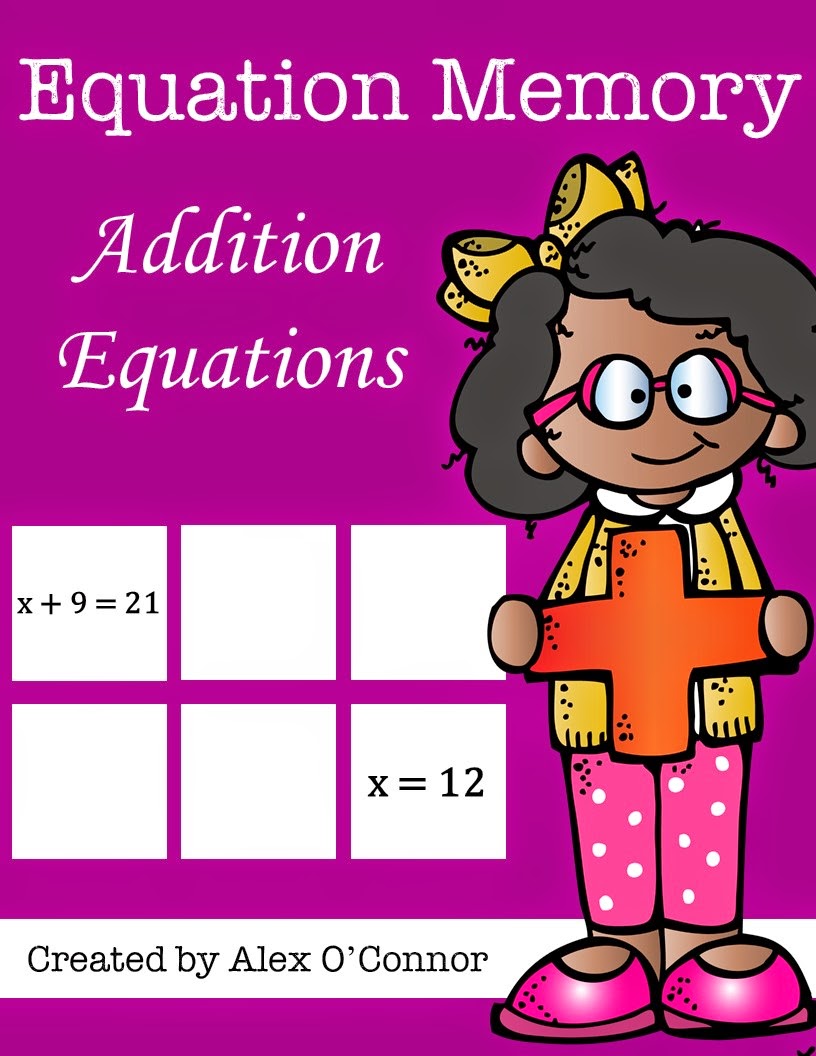
In 6th grade, we are nearing the end of our three algebra units. For us, that means we have had lots of practice writing and solving equations. Recently, we have moved on to writing, solving, and graphing inequalities! To help practice equations and inequalities I decided to create some memory games for my students to use during math centers.

https://www.teacherspayteachers.com/Product/Equation-Memory-Addition-Equations-1680829
I started with five different Equation Memory games - each focusing on a different type of equation (addition, subtraction, multiplication, division, two-step). Each game includes 24 cards. Half of the cards have an equation and half of the cards have the matching solutions. Students take turns trying to find the matches! My students have really enjoyed playing these games this week! My Equation Memory Addition game is free, so be sure to grab your copy!

Equation Memory Addition


You can also find the rest of my memory games in my TPT store. Click on the picture below to be linked to the Equation Memory Multiplication game!

https://www.teacherspayteachers.com/Product/Equation-Memory-Multiplication-Equations-1680790

After creating the five equation games, I also wanted to create a fun game for students to practice graphing inequalities. So often, my students struggle to remember whether to used a closed or open dot! This memory game practices matching the inequality with its graph. Not only must students recognize which type of dot is needed, they also must understand which direction the arrow points on the graph. I have found that these are the two most difficult concepts for students when graphing inequalities. Inequality Memory is a fun way for students to practice! You can also grab this one for free at the following link!


https://drive.google.com/file/d/0B6i7oME7DkjZdzhMREdUQXJxdXc/view?usp=sharing

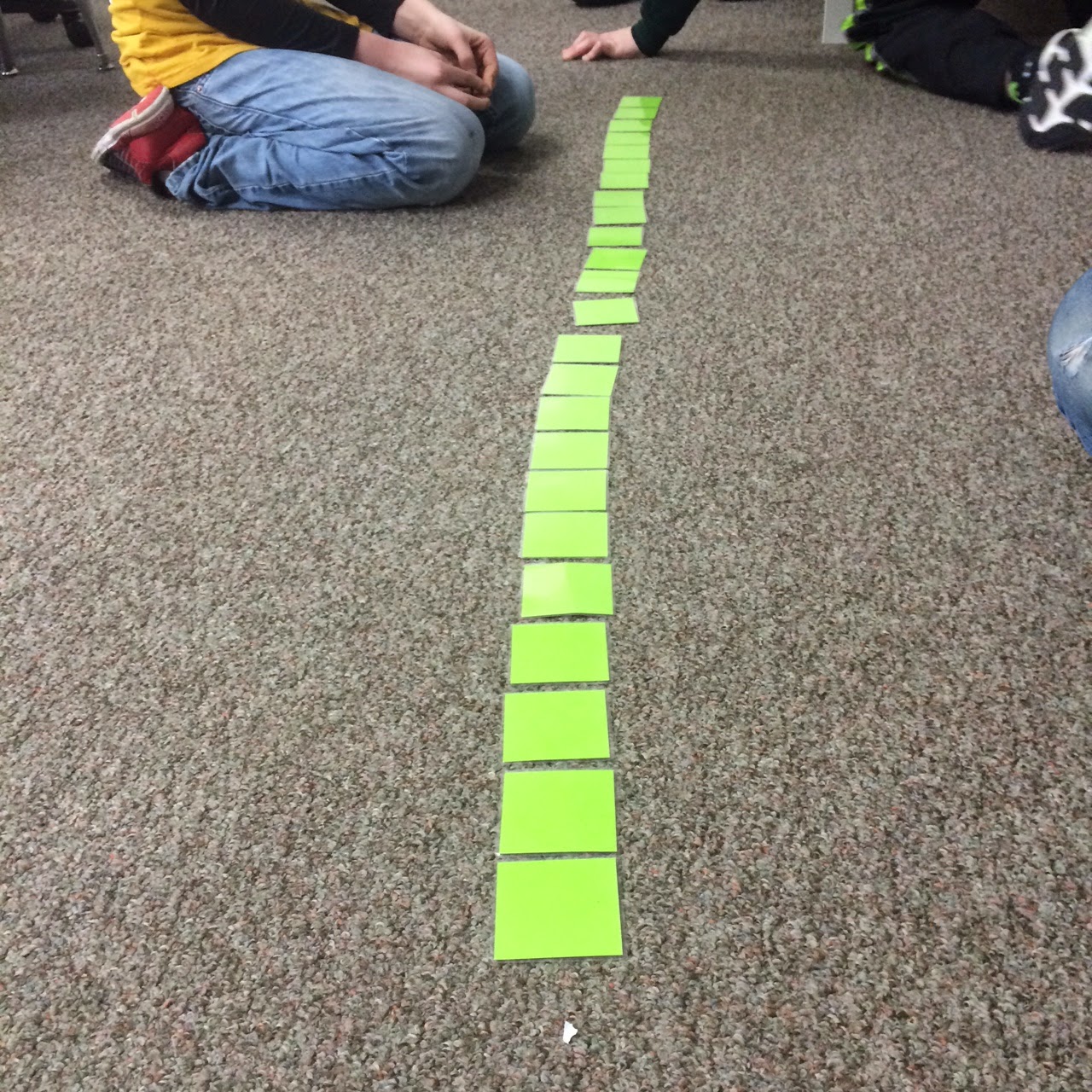
Yesterday my students were getting creative with how they set up the memory game! Typically they set up the 24 cards in a 6 by 4 rectangle, but these students wanted to set it up like this! If you would like to purchase all six of the memory games as a bundle, click on the picture!

https://www.teacherspayteachers.com/Product/Equation-Memory-Bundle-1680947